Cate Blanchett's Mary Katrantzou Dress: Best Harper's Bazaar Women of the Year Looks
Cate Blanchett's Mary Katrantzou dress brought wearable art to the 2026 Harper's Bazaar Women of the Year Awards. Explore the night's standout looks.
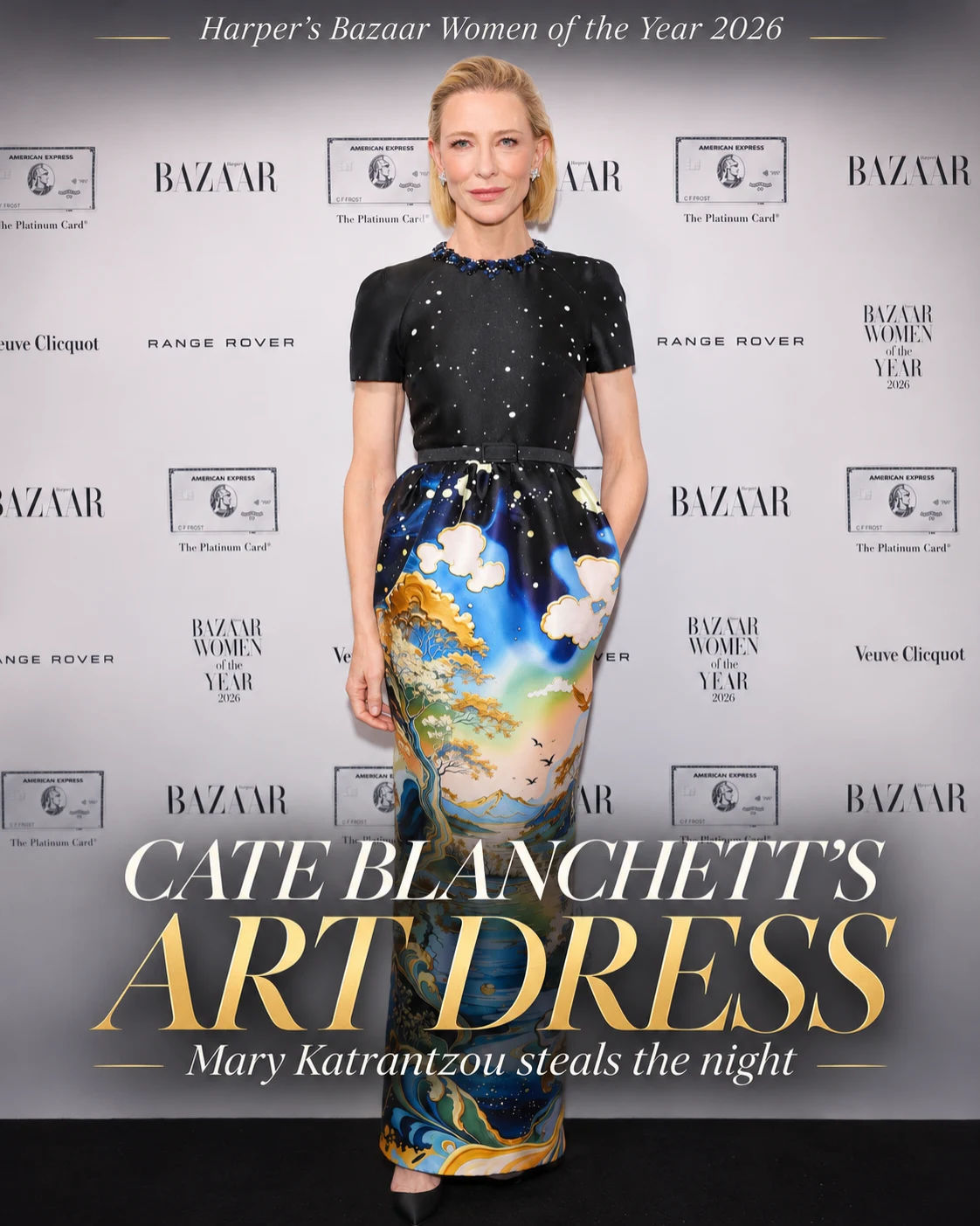
Some red-carpet looks are designed to impress at first glance. Others invite a second look, revealing new details, textures, and stories each time. Cate Blanchett's Mary Katrantzou dress at the 2026 Harper's Bazaar Women of the Year Awards belonged firmly to the latter category.
On November 5, London's Claridge's hotel welcomed influential women from film, fashion, literature, sport, and the arts for an evening celebrating creative achievement and cultural influence. Among the honorees was Blanchett, who received the Theatre Actress of the Year award. Her appearance captured the relationship between fashion and performance: a gown as carefully composed as a work of visual art.
Drawn from Mary Katrantzou's Resort 2027 collection, the dress unfolded like an imaginary landscape. A dark, celestial bodice gave way to sweeping illustrations of water, mountains, and golden foliage. There was drama in its composition, yet remarkable restraint in how Blanchett wore it.
Against an evening of sculptural silhouettes, luminous fabrics, and sophisticated tailoring, her appearance offered a compelling perspective on modern red-carpet elegance. It was a reminder that the most memorable fashion moments often have something more to offer than beauty alone.
Cate Blanchett's Mary Katrantzou Dress: A Landscape Worn Like Art
The most arresting detail of Cate Blanchett's Mary Katrantzou dress was its extraordinary sense of depth.
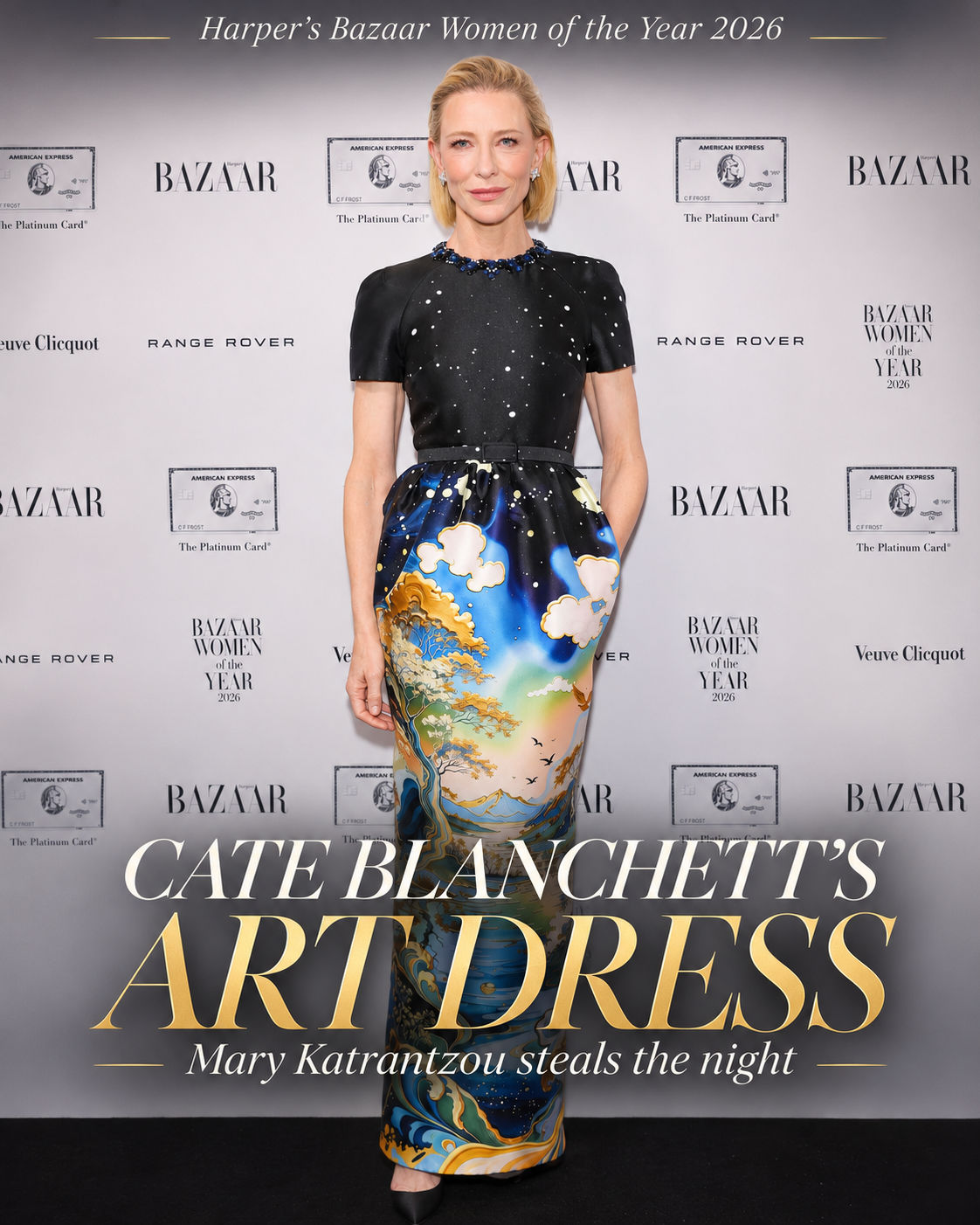
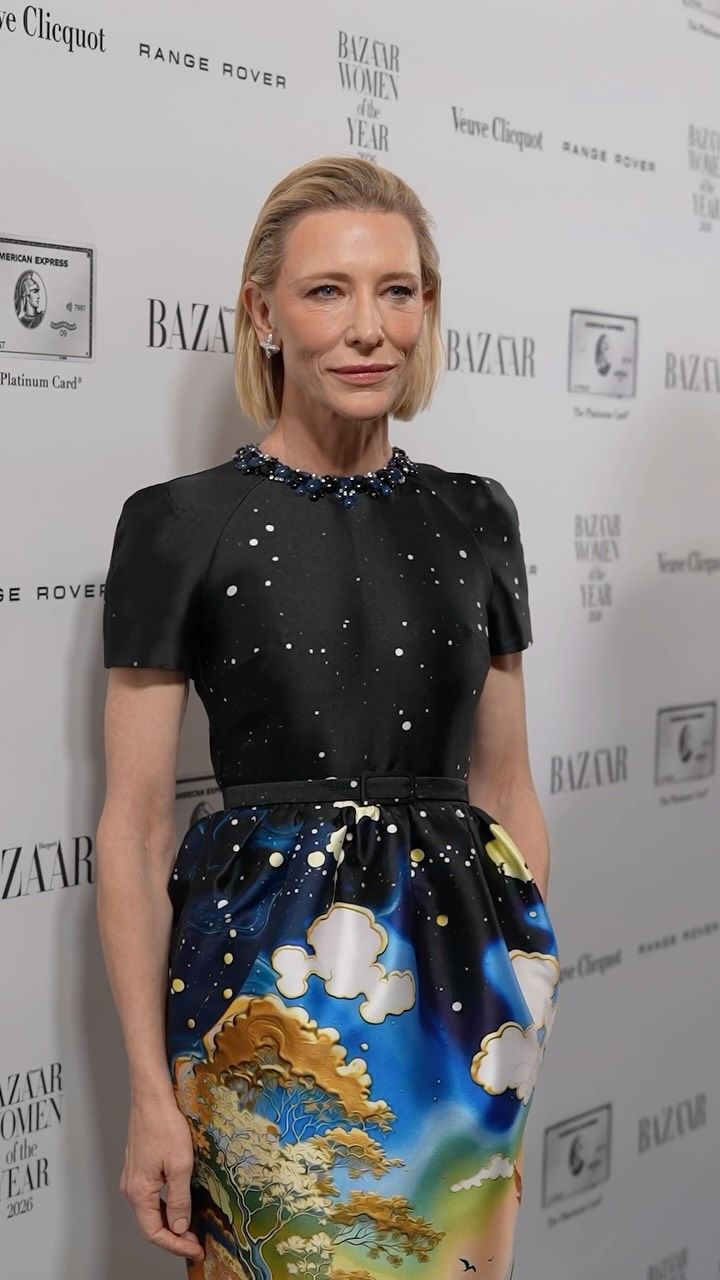
The Devana dress, presented in the Kintsugi Myth Azurite design, combined a structured, short-sleeved bodice with a floor-length skirt covered in intricate landscape imagery. The upper portion resembled a night sky, its dark surface punctuated by reflective embellishments. Deep-blue ornamentation around the neckline introduced another layer of texture, creating a striking frame for the design.
Below the defined waist, the visual language shifted.
Curling blue waves, golden trees, distant mountains, and stylized natural forms transformed the skirt into an expansive illustrated landscape. Metallic lines moved through the composition, while the elongated column silhouette provided enough structure to balance the elaborate print.
That tension between fantasy and discipline was central to the gown's appeal.
Katrantzou has long been associated with expressive printmaking, using textiles to explore the relationship between imagery, architecture, and the human form. Her Resort 2027 collection returned to fantastical environments, allowing intricate illustration and embellishment to take center stage.
On Blanchett, the approach felt particularly assured.
The gown commanded attention without demanding elaborate accessories. Louis Vuitton Idylle Blossom earrings provided a refined finishing detail, while the uninterrupted shape allowed the artwork to remain the focal point.
Nothing appeared to compete with the dress's visual complexity.
Blanchett's presence brought another dimension to the design. Her red-carpet wardrobe has frequently moved between architectural tailoring, sculptural eveningwear, and unconventional silhouettes. Throughout those varied appearances, she has demonstrated an ability to make ambitious fashion choices feel considered rather than theatrical for their own sake.
Here, that distinction mattered.
A gown containing so much visual information could easily overwhelm its wearer. Instead, the precise proportions, restrained styling, and Blanchett's composed presentation gave each element room to breathe.
The result was neither conventional evening glamour nor uncomplicated maximalism. It occupied a more intriguing space between the two, where extravagant craftsmanship met an understated approach to personal style.
Rather than wearing the dress as a spectacle, Blanchett allowed its artistry to unfold naturally.
Beyond the Gown: Mythology, Kintsugi, and the Beauty of Artistic Expression
The imagery on Blanchett's dress was more than an ornamental flourish. It belonged to a broader exploration of mythology, landscape, and artistic storytelling within Mary Katrantzou's Resort 2027 collection.
In July 2026, Katrantzou described the collection to Vogue as a return to fantastical, mythological worlds. The designer explored painterly landscapes and intensely detailed prints, incorporating visual effects that existed somewhere between traditional illustration and digitally heightened imagery.
That creative direction was unmistakable in Blanchett's gown.
Rather than depicting a single recognizable destination, the dress gathered familiar elements of nature into an imagined environment. Water appeared almost animated, mountains rose through the composition, and golden foliage introduced warmth against the cooler shades of blue.
There was something distinctly cinematic about the arrangement.
The dark upper half suggested the stillness of a night sky, while the skirt opened into a richly detailed world of movement and color. The contrast created a visual progression, allowing the garment to reveal itself gradually rather than presenting every detail at once.
Another important reference was kintsugi, the Japanese art of repairing broken ceramics with lacquer and precious-metal powder.
Instead of concealing the lines of repair, kintsugi makes them visible. Its distinctive aesthetic draws attention to the relationship between an object's original form and the changes it has undergone.
Katrantzou's design incorporated that visual language through metallic detailing woven into the landscape imagery. The reference added another dimension to the gown, connecting its fantastical scenery with a traditional decorative practice.
What made the dress compelling was the ease with which these influences coexisted.
Mythology introduced a sense of imagined worlds. Landscape imagery brought nature, distance, and movement into the composition. Kintsugi added an artistic reference rooted in transformation and visible craftsmanship.
Together, they created a garment with a richer visual vocabulary than color or silhouette alone could provide.
It would be easy to assign a single symbolic message to a dress this elaborate. Yet much of its beauty lay in its openness to interpretation. The artistic references were present without requiring a fixed narrative from the person wearing them.
For Blanchett, whose career spans film and theatre, the relationship between clothing and storytelling felt especially resonant.
The connection was aesthetic rather than literal. The gown did not need to represent one of her roles or communicate a particular personal experience. Its intricate imagery already carried a sense of drama.
That quality also gave the look an appeal beyond the trends of a single season.
Fashion's interest in sculptural surfaces, expressive craftsmanship, and art-inspired dressing continues to evolve. Yet the desire to wear something visually meaningful has a much longer history.
Blanchett's Mary Katrantzou dress found its place within that tradition: imaginative, intricately constructed, and presented with enough precision to remain elegant.

The Best Harper's Bazaar Women of the Year Looks: Different Visions of Elegance
While Cate Blanchett's Mary Katrantzou gown offered one of the evening's most elaborate visual moments, the wider Harper's Bazaar Women of the Year red carpet revealed an equally compelling variety of personal styles.
Rather than producing a single dominant aesthetic, the event brought together contrasting interpretations of glamour, from understated monochrome to dramatic tailoring and richly embellished eveningwear.
Mikey Madison approached the occasion through the language of classic Hollywood elegance.
Her strapless Dior dress, paired with Tiffany & Co. jewelry, offered a quieter expression of sophistication. Where Blanchett's design relied on intricate imagery, Madison's look emphasized shape, polish, and the enduring appeal of a carefully constructed formal silhouette.
Its strength came from restraint, with each element contributing to a cohesive appearance.
Elizabeth Debicki offered another interpretation of evening glamour in a custom velvet dress by Susie Cave.
The feather-trimmed design introduced softness and movement, creating a silhouette rooted in traditional eveningwear yet distinguished by its tactile finish. The luxurious surface contrasted with the illustrated complexity of Blanchett's gown.

Both appearances had a strong visual identity, although they achieved it through entirely different approaches.
Texture also played a defining role in Taylor Russell's Dior ensemble.
Covered in shimmering paillettes, Russell's black dress transformed a familiar eveningwear color into something more atmospheric. Its reflective surface created movement through light rather than print, resulting in a darker, moodier interpretation of formal glamour.
Meanwhile, Gugu Mbatha-Raw brought a softer perspective in a peach-toned Erdem dress.
With delicate lace detailing and asymmetric construction, the design balanced romantic femininity with subtle structural interest. Metallic Manolo Blahnik sandals complemented the look without distracting from its flowing lines.
Where Russell's appearance emphasized reflection and texture, Mbatha-Raw's relied on gentle color, intricate detailing, and movement.
Elsewhere, color itself became the defining feature.
Lesley Manville selected a crimson Alberta Ferretti caped gown, accompanied by a matching clutch. The saturated red gave the look immediate presence, while the cape introduced a sense of ceremony.
Its appeal came from the confidence of a single, sustained color story.

The evening also demonstrated that memorable red-carpet dressing does not always require a traditional gown.
Claudia Winkleman remained close to her distinctive style vocabulary in an Emilia Wickstead black blazer and checked shirt. The tailoring offered an alternative to conventional awards-night dressing, balancing familiarity with deliberate polish.
Letitia Wright explored modern form through a monochrome Prada ensemble, complemented by Cartier jewelry. Its unexpected proportions introduced a more experimental character, demonstrating how tailoring and silhouette can be just as expressive as embellishment.
For designer Sarah Burton, a sharply tailored black Givenchy suit of her own design made precision the defining aesthetic.
Burton, who received an award that evening, offered an appearance rooted in the authority of simplicity. The suit's clean structure placed emphasis on craftsmanship and proportion rather than ornamentation.
Together, these looks revealed why the Harper's Bazaar Women of the Year Awards offered such an interesting perspective on contemporary formal dressing.
The occasion brought together women whose careers and public identities were markedly different. Their wardrobes reflected that individuality.
Some favored familiar silhouettes elevated through craftsmanship. Others embraced intricate embellishment, unusual proportions, expressive color, or a more understated approach to glamour.
The collective result was a red carpet defined less by uniformity than by personal expression.
Within that range, Blanchett's gown occupied a distinctive position.
It was among the evening's most visually narrative designs, using the dress itself as a canvas for elaborate storytelling. Yet its intricacy did not diminish the appeal of the quieter looks around it.
Instead, the contrast revealed how many different forms elegance can take.
A precisely tailored black suit, a feather-trimmed velvet gown, and a mythological landscape illustrated across an evening dress can each communicate confidence in their own way.
What connected the strongest appearances was not a shared trend or aesthetic formula, but a clear sense of intention.

When Personal Style Becomes a Lasting Statement
The most memorable red-carpet moments often outlast the occasions that introduced them.
They remain compelling not simply because they captured a particular fashion trend, but because the relationship between the wearer, the design, and the setting felt complete.
Cate Blanchett's Mary Katrantzou dress at the 2026 Harper's Bazaar Women of the Year Awards possessed that quality.
Its elaborate landscape, celestial detailing, and sculptural construction offered plenty to examine. Yet the lasting impression came from the harmony of those elements, creating an appearance that was visually ambitious without losing its composure.
The gown also illustrated something enduring about fashion as a creative medium.
Clothing can preserve artistic references, reinterpret traditional techniques, and bring imagined worlds into contemporary visual culture. On a red carpet, those ideas become visible far beyond the runway, finding new meaning through the individuals who wear them.
Blanchett's appearance made that exchange feel effortless.
Surrounded by women celebrating achievements across the arts, entertainment, fashion, and public life, she wore a design that valued imagination as much as beauty.
And while the evening's other standout looks explored glamour through color, texture, structure, and simplicity, her Mary Katrantzou gown offered a particularly evocative reminder of what exceptional red-carpet dressing can achieve.
It can create an image that lingers long after the photographs have circulated.
Not simply because the dress was beautiful, but because there was something within it worth discovering again.

Recommended
Kylie Jenner Pink Halter Look: How Coquette Glam Is Returning for Fall
Victoria Beckham Salted Caramel Suit: The Autumn Tailoring Trend
Monica Barbaro Blue Dior Dress: Late Summer Eveningwear Style Guide
Penélope Cruz Yellow Chanel Dress: Best Red Carpet Look at London Film Festival 2026
Lily James Crushed Velvet Prada Dress: Best London Film Festival Style
More from ICONS
ALL ICONS
Victoria Beckham’s All-Black Paris Premiere Look Is a Masterclass in Power Dressing
Bambi Print Trend 2026: Why Deer Spots Are Replacing Leopard Print on TikTok