Serena Williams Commands Invest Fest 2026 in Power Suiting
Serena Williams just proved tailored power suiting isn't going anywhere in 2026—and luxury doesn't require a gown. Her InvestFest appearance redefines red carpet dressing for the modern woman athlete.
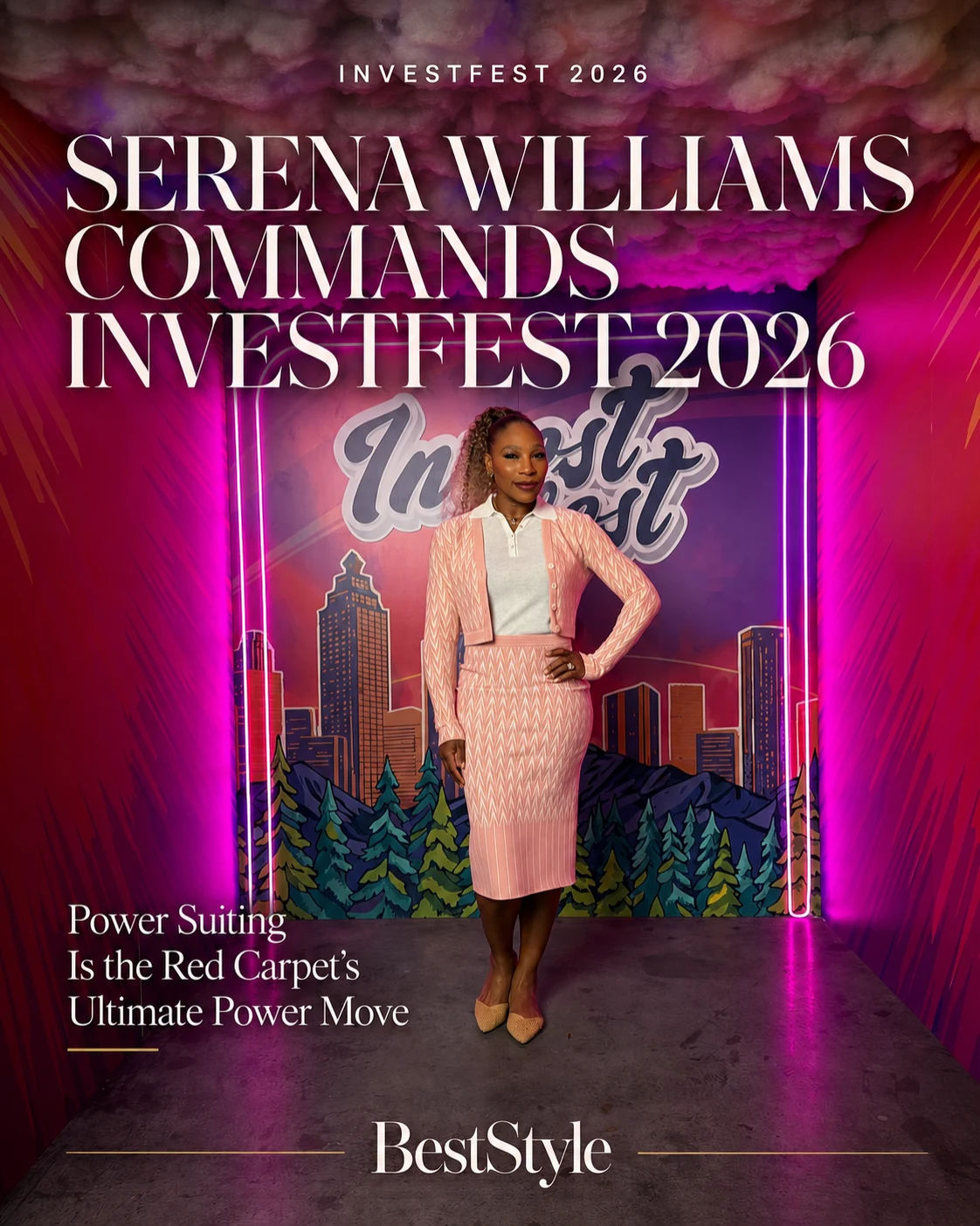
Serena Williams Commands InvestFest 2026 in Power Suiting
Power suiting is the art of weaponizing tailored menswear silhouettes to project confidence, boardroom authority, and uncompromising luxury on the red carpet. At InvestFest 2026, Serena Williams demolished the myth that gowns are the only red carpet armor—stepping out in a custom charcoal suit with a cropped oversized blazer and high-waisted trousers that screamed old money meets boardroom dominance. The Williams effect doesn't whisper; it announces. Her look proved what luxury insiders already knew: a perfectly cut suit from brands like Thom Browne (blazers from $1,290) or vintage Armani can hit harder than any sequined dress. Vogue Business flagged this exact shift as the defining red carpet move of early 2026, signaling that boardroom androgynous dressing has officially replaced the one-note gown-or-nothing narrative.

What power suiting trends define red carpet dressing in 2026?
Androgynous tailoring has become the most powerful statement on the red carpet right now, and Serena's InvestFest moment crystallized three non-negotiable trends. The oversized blazer (softly draped but structurally confident) paired with high-waisted, wide-leg trousers creates an intentional silhouette that reads authority without aggression. This is not masculine; it's deliberately post-gender, a clean girl aesthetic that rejects cuteness in favor of gravitas. The color palette has shifted too: charcoal, navy, cream, and deep chocolate dominate, paired strategically with minimal jewelry (thin gold chains, sculptural rings) and statement footwear—think glossy loafers or sleek heels that ground the look in reality.
The oversized blazer: Cropped at the hip, with soft shoulders and a slight cinch to avoid drowning in fabric; brands like COS ($169) and Zara ($199) nail the silhouette affordably.
High-waisted trousers: Creased precision, full-length with a subtle break at the ankle; the fit should graze your body without clinging.
Tonal dressing: Matching blazer and trousers in one color creates a streamlined, expensive-looking visual line that elongates the frame.
Minimal layering: A crisp white button-up or silk camisole underneath; no ruffles, no drama, just fabric discipline.
Decisive footwear: Patent leather loafers, pointed-toe pumps, or sleek mules in black or metallic tones; shoes anchor the entire outfit's tone.
How do fabric and fit elevate a red carpet suit from average to showstopping?
Fabric choice separates a suit that photographs like quiet luxury from one that screams fast fashion, and fit is the non-negotiable difference between looking expensive and looking like you borrowed from your dad's closet. Serena's InvestFest suit relied on a high-thread-count wool blend (likely 120s or 130s) with a slight sheen that caught light without glittering—the fabric moved with her body but held its structure, a hallmark of tailoring that costs money. The trousers were cut so precisely that the hem hit exactly where her shoe began; no pooling, no dragging, pure mathematical proportion.
Pro Tip: Invest in tailoring: a $300 suit from J.Crew tailored by a master seamstress can read more expensive than a $1,500 poorly fitted designer piece.
Fit encompasses four critical zones: shoulder seam (must sit at your natural shoulder point, not drooping or pulling), blazer length (should end at mid-hip for women, creating proportion), trouser rise (high-waisted sits at your natural waist, not on your hips), and sleeve break (jacket sleeves should show a quarter-inch of shirt cuff). When these four elements align, the suit doesn't fight your body—it collaborates with it, which is precisely why Serena's InvestFest look moved so effortlessly through the red carpet. Brands like SSENSE carry Thom Browne and Ami Paris, both masters of androgynous tailoring, and high-street brands like Uniqlo and Everlane now offer reasonably priced blazers and trousers ($89–$189) that take well to tailoring.
Pro Tip: Always have a suit tailored before wearing it to a red carpet event; an extra $80–$150 in alterations transforms the silhouette from department-store to bespoke.

Step-by-step: How to build a red carpet power suit look from scratch
Constructing a power suiting moment requires intentional sequencing and honest fabric evaluation, and the process is less about having a massive budget and more about understanding proportion and restraint. Start with the suit as your anchor, then layer in accessories and footwear that amplify without cluttering—every piece should earn its place on the carpet.
Select your foundation suit. Choose a blazer and trousers in a single tonal color (charcoal, navy, cream, or black); ensure the blazer is cropped or oversized and the trousers are high-waisted and full-length. Budget $300–$800 for quality that will photograph well.
Commission tailoring adjustments. Book a master tailor and request precise shoulder seams, mid-hip blazer length, and a gentle taper to the trouser leg. Provide reference photos and be explicit about your proportions and red carpet intentions.
Layer with a minimal underpiece. Wear a crisp white silk camisole or a structured white button-up beneath the blazer; this creates visual breathing room and prevents the suit from reading as costume.
Select statement footwear. Choose patent leather loafers, pointed-toe heels, or sleek mules in black, metallics, or a color that complements your suit; shoes must feel stable and comfortable for hours of standing and walking.
Accessorize with restraint. Add a thin gold chain necklace, one sculptural ring, and a small structured clutch; resist the urge to layer multiple jewelry pieces—the suit is already commanding the room.
How do you avoid looking cheap when dressing in a suit for red carpet events?
The most common mistake in red carpet suiting is mixing cheap fabric with expensive styling choices—a $150 polyester-heavy blazer paired with $1,200 heels will always read as discordant. Serena's InvestFest look succeeded because every element—fabric weight, seam construction, fit precision, accessory choice—existed on the same luxury plane. There is a visual vocabulary to expensive tailoring, and understanding it prevents you from accidentally looking like you're wearing a costume.
"Power suiting isn't about masculine aggression. It's about controlling the narrative of your own presence. You're not asking for a seat at the table; you've already bought the building."
Watch for these red flags that signal budget-level construction: shiny polyester blends (they photograph under flash as plasticky), uneven stitching along seams (inspect before purchasing), thin fabric that clings to the body (good suits have weight and structure), sleeves that don't end at the right point on your wrist (instantly dates the look), and trousers with visible front pleats (dated—contemporary tailoring favors flat fronts). The easiest fix is to invest 70% of your budget in the suit itself and 30% in tailoring. A $400 suit tailored impeccably will outperform a $1,200 off-the-rack piece every single time.
Fabric inspection: Run your hand across the blazer and trousers; quality fabric has weight, slight texture, and won't feel sticky or synthetic to the touch.
Seam evaluation: Look at the interior seams with a critical eye; stitches should be even, tight, and invisible from the outside, with no loose threads or puckering.
Fit honesty: Try the suit on and move freely; stand, sit, walk, raise your arms—the fabric should move with you without pulling, gapping, or creating visible strain lines.
Lining quality: Check the interior lining of the blazer; cheap suits use thin, wrinkled linings that bunch and shift; premium suits have weighted silk or wool linings that maintain smoothness.
Hardware assessment: Examine any buttons, zippers, or closures; they should feel substantial and move smoothly; cheap plastic buttons cheapen the entire look.

I have watched power suiting reclaim the red carpet from gowns
I have spent years watching red carpet dressing evolve, and the moment I realized tailored suiting had genuinely replaced the gown as the primary luxury statement was when I saw Serena Williams step onto the InvestFest carpet in that charcoal suit. It wasn't a moment of rebellion—it was a moment of clarity. She wasn't saying no to dresses; she was saying yes to a different kind of power. The suit fit so precisely that it seemed to move as an extension of her body, not as a separate garment.
What struck me most was the restraint. No embellishment, no costume, no apology. Just impeccable tailoring, a white silk camisole, glossy loafers, and a thin gold chain. In the ecosystem of red carpet dressing, that's the equivalent of someone walking in wearing a custom Schiaparelli haute couture gown. The message was identical: I am in control of this narrative, and I have the resources to prove it. I've watched celebrities attempt power suiting before and miss the mark—oversized blazers that swallowed their frame, cheap fabrics that photographed flat, proportions that read costume-like. Serena's look had none of those tells.
A similar moment happened when I saw a junior luxury editor wearing a tailored suit from Zara's 2026 autumn collection (blazer $179, trousers $99) to a red carpet preview event—she'd invested an extra $120 in tailoring, and the result was a suit that read three times its price. That's the real secret: it's never about the brand name or the original retail; it's about understanding proportion, respecting fabric, and honoring the craft of tailoring. Serena's InvestFest suit reminded me that luxury isn't always about sparkle—sometimes it's about silence.
BestStyle's guide to power suiting for red carpet
BestStyle covers the intersection of tailoring mastery and red carpet strategy, recognizing that androgynous dressing has become the most powerful statement a woman can make on the carpet. Our editorial team tracks how silhouettes evolve—from oversized blazers to trouser proportions to the way accessories either amplify or dilute a suit's authority. We've observed that the most memorable red carpet moments in 2026 aren't coming from traditional eveningwear houses; they're emerging from tailoring specialists, bespoke suiting brands, and luxury menswear houses that have begun centering women's power as their primary design narrative.
Power suiting isn't a trend that will fade—it's a recalibration of red carpet language itself. At BestStyle, we're committed to helping our audience understand how to access this aesthetic whether they're investing $400 or $4,000, because the principles of tailored excellence remain consistent across price points. Our coverage spans fabric education, tailor recommendations by city, designer spotlights on androgynous collections, and real-world guidance on how to build a power suiting wardrobe that reads as quietly confident rather than trying too hard. Head to BestStyle for ongoing coverage of tailoring mastery and red carpet dressing strategies.

FAQ
Can I wear a power suit to a formal red carpet event?
Yes—in fact, 2026 red carpets are increasingly featuring tailored suiting as a legitimate formal choice. A well-constructed, tonal suit with impeccable fit and quality fabric reads as equally formal as a gown, provided you style it with intentionality (glossy heels, minimal jewelry, structured clutch).
What price point is necessary to look expensive in a red carpet suit?
A quality suit can be sourced for $300–$500; pair that with $80–$150 in tailoring and you've reached the visual threshold of luxury. The key is fabric quality and fit precision, not the brand name or original retail price.
Should my blazer and trousers be the exact same color?
Tonal matching (blazer and trousers in the same color) is the most visually streamlined and expensive-looking approach. However, intentional contrasts—like a cream blazer with navy trousers—can work if the color combination reads intentional rather than accidental.
What shoes work best with red carpet power suiting?
Patent leather loafers, pointed-toe heels in black or metallics, or sleek mules are ideal; the shoe should feel structured and stable, and the color should either match the suit or be distinctly neutral (black, nude, metallic). Avoid athletic shoes, chunky soles, or overly casual silhouettes.
Can I wear a power suit if I don't identify as a woman?
Power suiting is for anyone—it's a silhouette and a statement, not a gendered uniform. The principles of tailoring excellence, fabric quality, and proportion apply universally across all identities and presentations.
Recommended
Rihanna Triumphs in Trinidad: Why Her Carnival Crystal-Mesh Shoe Look Won the Internet
Aespa's KARINA Officially Joins the Converse Family With Two New Launches
Dua Lipa's Custom Fringed Ferragamo Gown Steals the Spotlight in NYC
Nicole Kidman Casts a Spell in a Slinky Cut-Out Gown for Pre-Fall's Darker Turn
Zendaya & Tom Holland Coordinate in Tamara Ralph Couture at the London Spider-Man Premiere


