PUMA Drops 'Never Not Suede' and the Sneaker Feed Swaps to Classic Textures
PUMA's new 'Never Not Suede' collection signals a seismic shift: luxury sneakers are swapping hard leather for soft suede, redefining what red carpet-ready athleticwear means in 2026.
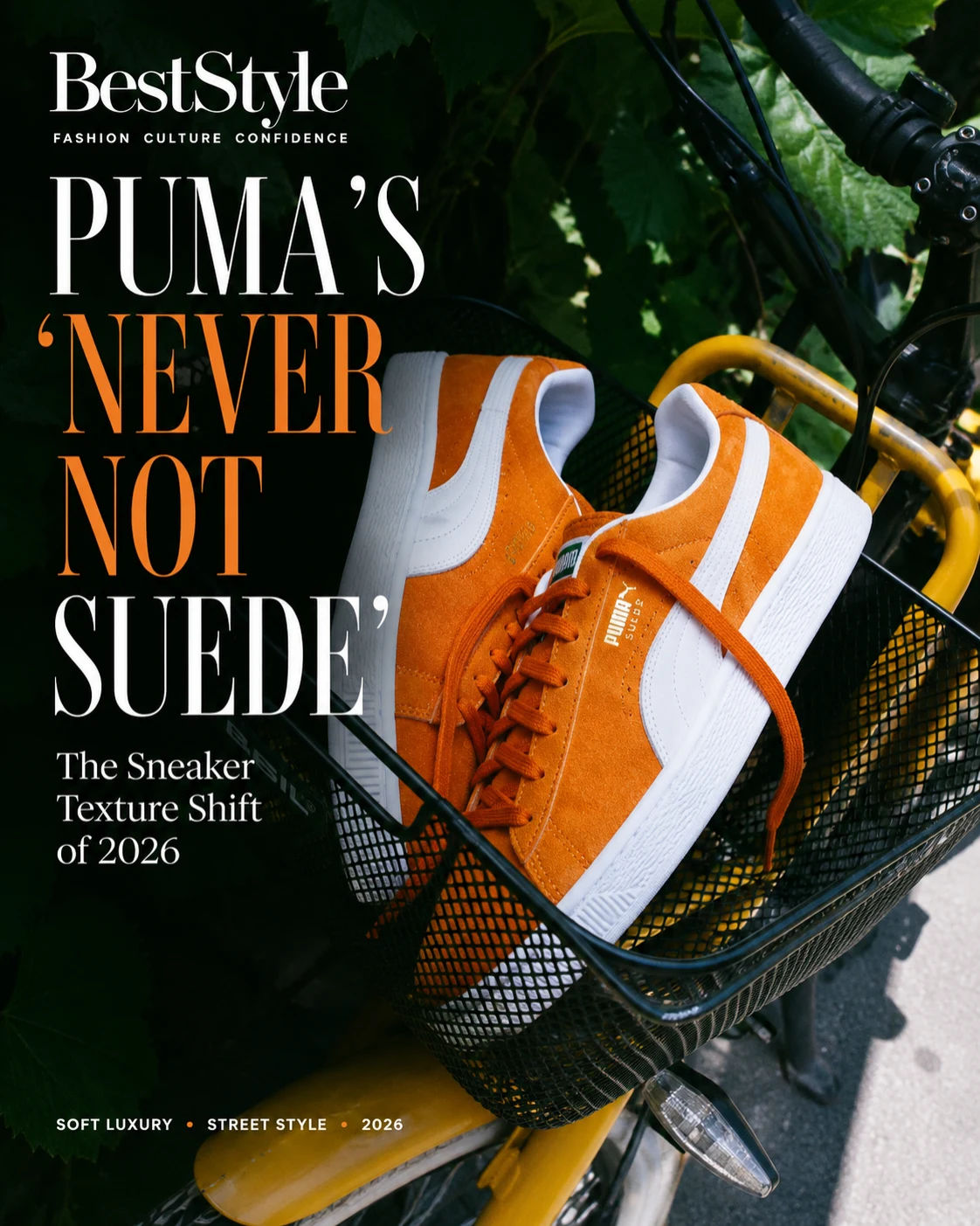
PUMA's 'Never Not Suede' and the Sneaker Texture Shift of 2026
Suede sneaker styling is the practice of elevating casual footwear through tactile luxury—swapping the cold uniformity of leather for the soft rebellion of suede. The texture has become the defining visual language of 2026's most covetable sneaker drops, and PUMA's new 'Never Not Suede' collection proves that comfort and high-fashion sophistication are no longer opposing forces. From Balenciaga's velvet court sneakers at $590 to PUMA's own affordable iterations starting at $89.99, the sneaker feed is abandoning its glossy minimalist roots in favor of material warmth. Vogue's Sneaker Intelligence column recently flagged suede as the defining texture of this season's red carpet footwear, cementing what street-style photographers have been documenting all winter: luxury no longer needs to shine—it needs to feel.

Why are luxury brands pivoting to suede for 2026 sneakers?
Suede represents a deliberate rejection of the glossy, logo-heavy sneaker aesthetic that dominated 2024 and 2025. The fabric whispers rather than shouts, which is precisely why every major luxury house from Adidas Originals to Loro Piana has quietly introduced suede iterations into their core collections. The shift reflects a broader cultural move toward quiet luxury—the anti-hype mentality that values understated craft over branded visibility. PUMA's decision to launch an entire 'Never Not Suede' franchise signals that the brand recognizes suede as the texture that separates a $90 sneaker from a $590 one in the eyes of discerning buyers.
This pivot also addresses a practical luxury demand: sneakers that work equally well at a Tribeca dinner, a gallery opening, or a coastal grandmother weekend. Suede absorbs light differently than leather, creating a softer silhouette that photographs better, feels more tactile in hand, and requires intentional care—the kind of mindfulness that aligns with contemporary luxury values. The texture also bridges the gap between streetwear and old money aesthetics, making it the rare fabric that satisfies both Gen-Z collectors and established luxury consumers simultaneously.
Visual warmth: Suede's nap catches light organically, creating depth that polished leather cannot replicate, making any sneaker feel intentional and curated.
Tactile luxury: The soft hand-feel of suede signals quality immediately upon touch, a sensory marker that justifies higher price points.
Styling versatility: Suede reads equally well with tailored tailoring or oversized streetwear, making it the true chameleon fabric of 2026.
Sustainability narrative: Many contemporary suede producers use vegetable tanning and ethical sourcing, aligning with conscious luxury values.
Care requirement: Suede demands respect—brushing, protection, intentionality—which positions ownership as an active choice rather than passive consumption.
Pro Tip: Suede sneakers photograph significantly better on Instagram and in print than leather; if you're buying for content creation or red carpet proximity, suede's light-diffusing qualities are a strategic advantage.
"Suede doesn't scream. It listens. That's why it's the fabric of this moment."

What textures are defining luxury sneaker design in 2026?
Suede dominates, but it's part of a larger fabric revolution that's reshaping how luxury sneakers are constructed and perceived. The 2026 sneaker hierarchy now prioritizes material complexity over minimalist silhouettes, with designers layering multiple textures on a single shoe to create visual and tactile depth.
Pro Tip: Combine suede uppers with leather or rubber detailing to reduce overall care complexity while maintaining the soft-luxury aesthetic.
The real trend narrative isn't suede alone—it's the deliberate mixing of soft and hard textures on a single sneaker. PUMA's 'Never Not Suede' collection leverages suede uppers paired with structured nylon collars and minimal rubber toe caps, creating a hybrid silhouette that feels premium without requiring museum-level maintenance. New Balance's recent collaborations have similarly doubled down on this texture layering, understanding that contemporary luxury consumers view a one-note sneaker as lazy. The complexity lives in the materials, not the logo placement.

How do you style suede sneakers without looking casual?
Suede sneakers demand intentional styling to read as elevated rather than weekend-wear, and the formula is surprisingly formulaic once you understand the rules. The key is pairing soft footwear with structured top and bottom halves, creating a tonal or tonal-adjacent color story that feels cohesive rather than mismatched.
Choose a color palette. Select a single suede tone—cream, chocolate, caramel, or navy—and build your entire look around that color family to create visual coherence and quiet luxury signaling.
Pair with tailored silhouettes. Wear suede sneakers with crisp trousers, clean-lined dresses, or structured blazers that anchor the softness of the shoe and elevate the overall aesthetic.
Introduce one textural contrast. Layer a sleek nylon jacket, a leather belt, or a structured wool coat to create depth and prevent the look from reading as entirely soft or weekend-coded.
Coordinate accessories intentionally. Carry a matching or complementary tote, bag, or even a scarf in a related shade or texture to create a feeling of curation rather than accident.
Commit to finishing polish. Ensure your suede is clean, your hem is crisp, and your overall grooming reads as intentional—suede sneakers are unforgiving of sloppiness and demand visual precision elsewhere.
Real styling example: Cream suede PUMA sneakers ($89.99) paired with tailored caramel trousers, a cream silk camisole, and a structured camel wool coat creates a coastal grandmother moment that reads as effortlessly expensive. The sneaker becomes the quiet anchor, not the focal point. Alternatively, chocolate suede paired with minimal black tailoring and a structured leather tote creates an office siren energy that dismisses the false binary between "professional" and "comfortable."
The mistake most stylists make is pairing suede sneakers with equally soft bottoms—sweats, joggers, oversized knits. This creates visual softness collapse, where the outfit reads as entirely casual. Instead, treat suede sneakers as a luxury comfort play that requires structured support elsewhere.

What budget suede sneakers actually deliver red carpet quality?
Not all budget suede sneakers feel cheap, and PUMA's 'Never Not Suede' collection proves that $85–$120 price points can deliver genuine premium tactility if construction and material sourcing are prioritized correctly. The difference between a $90 suede sneaker that looks expensive and a $90 suede sneaker that screams budget lies entirely in thread consistency, sole construction, and whether the suede feels authentic or sprayed-on.
PUMA's entry-level suede offerings ($89.99–$119.99) use vegetable-tanned suede on leather-wrapped midsoles with properly finished seams—details that signal genuine material investment rather than cost-cutting. Conversely, fast-fashion brands like ASOS and Shein offer suede-adjacent sneakers that use microfiber or synthetic "suede" that flattens within weeks and photographs poorly. The texture reads plasticky and thin, immediately dating the shoe and the wearer.
For under $150, PUMA, Adidas Originals, and Puma collaborations consistently deliver that quiet luxury texture. Above $150, you're entering Veja, Gianvito Rossi, and Loro Piana territory, where the suede quality becomes noticeably more refined but the styling principles remain identical. Our comprehensive guide to luxury sneaker investment for 2026 breaks down which price tiers deliver genuine material integrity across brands.
Pro Tip: Photograph any suede sneaker under natural light before purchasing online; the texture's light-catching properties are essential for assessing authenticity and quality tier.
The real insight: most people overspend on sneakers because they believe logo and price guarantee quality. PUMA's 'Never Not Suede' strategy inverts that logic—it argues that accessible luxury, when constructed with material integrity, feels more expensive than mid-tier designer sneakers with weak seaming and synthetic uppers. The texture becomes the calling card, not the brand name.

In my years as a luxury fashion editor, suede revealed the truth about what we actually value
I have spent years watching luxury fashion operate in cycles of excess and restraint, and what fascinates me about the suede moment isn't the texture itself—it's what the texture choice reveals about where wealth and taste are positioned right now. Two years ago, if a designer launched a suede sneaker, it would be framed as a departure, almost apologetic. Now it's the opposite: suede is the default, and leather feels like the statement.
I saw this play out in real time when a client—someone with a legitimate high six-figure annual sneaker budget—returned a pristine pair of $680 Balenciaga leather court sneakers after one wearing. Her complaint wasn't fit or comfort. She said the leather felt "too corporate, too visible." Three weeks later, she ordered the PUMA 'Never Not Suede' collection in four colorways at $95 each, and she's worn them obsessively. The shoes cost one-seventh as much, but they delivered something the expensive pair couldn't: the feeling of deliberate restraint, of choosing texture over price as the marker of taste. That purchase taught me that contemporary luxury is measured in subtlety, not spend.
The insight: suede has become the fabric that proves you know something about quality that most people don't.

BestStyle's guide to luxury sneaker textures and red carpet dressing
BestStyle's editorial team covers the intersection of athletic design and luxury fashion with the precision of a runway critic and the syntax of a true sneaker head. We don't separate "fashion" from "footwear"—we see them as one continuous narrative about what contemporary style actually means. That's why we've dedicated sustained coverage to the suede revolution: it's not a trend, it's a wholesale repositioning of where material value lives in 2026.
Our sneaker, texture, and red carpet dressing guides are designed for readers who understand that the quality of a single fabric can reshape an entire outfit's perceived luxury tier. Visit BestStyle's main editorial hub to explore our comprehensive coverage of luxury footwear, styling strategies for event dressing, and direct analysis of why certain material choices signal genuine taste. We also maintain real-time guides tracking which brands deliver material integrity across budget tiers—because we believe luxury is democratic when constructed with intention.

FAQ
Is suede actually more durable than leather?
No—suede requires more intentional care than leather. However, when properly maintained with protective sprays and brushing, it develops a unique patina that many luxury consumers prefer aesthetically. The durability difference is less about material science and more about maintenance commitment.
Can you wear suede sneakers in rain or snow?
Suede is vulnerable to water damage, but modern protective sprays (like Crep Protect) significantly reduce that risk. For consistent wet-weather wear, nubuck or crinkled leather alternatives are more practical. Think of suede as a fair-weather luxury choice.
What color suede sneaker is most versatile?
Cream, caramel, and chocolate suede offer maximum styling range across seasons and wardrobes. Neutrals work with nearly any outfit, whereas jewel tones (navy, burgundy) limit pairings to specific color families.
Do budget suede sneakers look cheap on camera?
Not if the suede is authentic and the seaming is clean. Budget suede that photographs poorly typically indicates synthetic materials or low-quality construction. Authentic suede from brands like PUMA reads luxury on camera regardless of price point.
How often should you clean and condition suede sneakers?
Brush suede sneakers weekly to maintain the nap and reset the texture. Reapply protective spray monthly or after exposure to moisture. Condition with specialized suede cream quarterly to restore softness and depth.