The 'Adam Sandler' Festival Shift: Why Comfort-First Normcore is Replacing Sequins This Morning
Sequins are out. Oversized linen and sneakers are in. Here's how to work comfort-forward red carpet dressing into your luxury wardrobe.
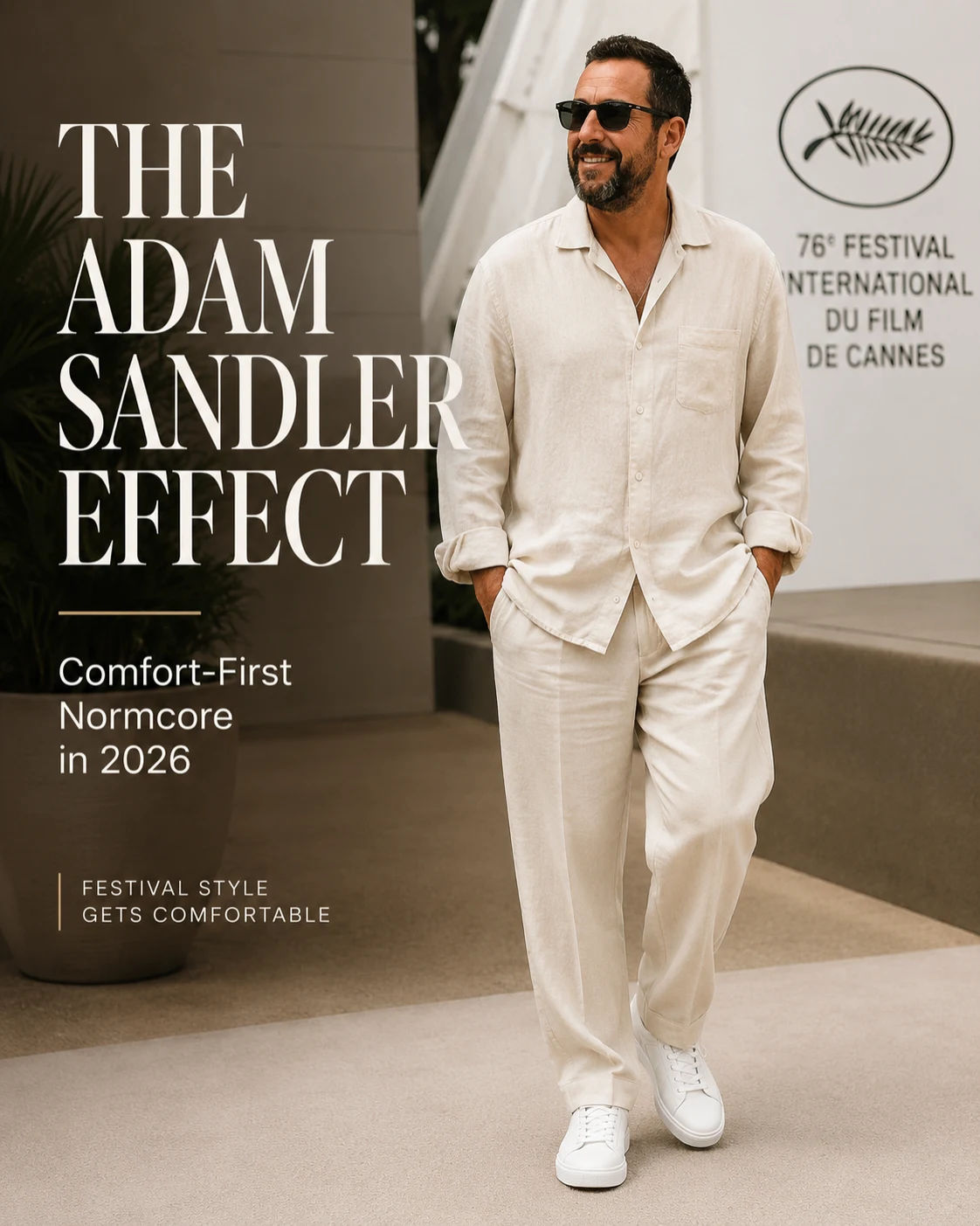
The 'Adam Sandler' Festival Shift: Why Comfort-First Normcore is Replacing Sequins This Morning
Comfort-first normcore is the practice of dressing for high-stakes events—galas, premieres, festival appearances—in pieces that prioritize ease and wearability over traditional red carpet theatricality. This seismic shift away from sequined excess and toward quiet luxury basics represents one of 2026's most audacious style corrections, signaling that true power now lives in an oversized linen button-up and pristine white sneakers rather than a seven-pound couture gown. Brands like Khaite are pricing premium normcore staples from $425, while UNIQLO's elevated basics deliver the same intentional minimalism for under $80. Vogue's recent trend analysis and TikTok's @normcore aesthetic community have cemented this movement as the defining visual language of this moment.

What red carpet trends should budget shoppers focus on in 2026?
The smartest red carpet move this year is abandoning the algorithm's demand for maximum visual noise and instead investing in monochromatic, oversized, and textural pieces that whisper rather than shout.
Oversized linen blazers: Unstructured, rumpled-looking, and available at Everlane ($148) and COS ($189). The wrinkles are the point—they read as deliberately undone.
Cream and beige tonal dressing: Matching your top and bottom in the same neutral shade creates an elegant visual line. Zara offers tonal sets from $59.99.
Minimal jewelry: One thin gold chain or a single pearl stud. The absence of bling is the luxury statement.
Clean-girl sneakers or ballet flats: New Balance, Veja, or Repetto ballet pointe shoes (from $89.99 at DSW). Athletic-luxe footwear is non-negotiable.
Texture over embellishment: Corduroy, organic cotton, linen, and raw-edge seaming replace rhinestones and sequins entirely.
Pro Tip: Thrift a designer linen shirt at a luxury consignment site like Vestiaire Collective; you'll spend $40–80 and own a piece that screams intentional restraint.
"The most expensive-looking outfit is the one that doesn't try. The Adam Sandler effect is real—and it's winning."

How do fabric and fit determine whether a budget dress looks expensive?
The line between a $40 dress that reads as a $400 piece lives entirely in fiber content and tailoring precision.
FabricTypical Cost (Budget)Luxury ReadCare & Maintenance100% Linen$39–98Very HighSteam before wear; wrinkles add characterOrganic Cotton$35–80HighLow-temp wash; lay flat to drySilk Blend (20–30%)$55–140Very HighDry clean or hand wash gentlyCorduroy (Cotton)$45–95HighMachine wash; brush nap before wearPolyester Blend (70%+)$15–40LowEasy care; reads as "cheap" regardless
Pro Tip: Fit beats fabric: a perfectly tailored $50 UNIQLO shirt will read as luxury the moment the shoulders land precisely at your bone, sleeves end mid-wrist, and the hem grazes your hip.
The reason a linen piece reads as "expensive" is because linen, even at budget price points, has inherent visual weight and texture. When that linen is cut with clean lines and sits on your body without bunching or pulling, the overall impression becomes aspirational. Fit is where most budget pieces fail—oversized on the wrong body part, too-short sleeves, hems that hit awkwardly. The fix: take pieces to a tailor for $20–40 per adjustment. This small investment transforms a $60 blazer into a $600-feeling garment.

Step-by-step strategies to find affordable gala outfits that look red carpet ready
Building a red carpet-worthy outfit on a budget requires a deliberate, methodical approach—less impulse shopping, more strategic layering and thrifting.
Start with a baseline neutral. Choose one neutral (cream, beige, black, gray, or charcoal) as your anchor piece. This might be a tailored blazer from COS ($189) or a linen shirt from Everlane ($98).
Layer in texture intentionally. Add one piece with tactile interest—corduroy trousers, a linen blend that's slightly nubby, or a silk-adjacent fabric from H&M's conscious collection ($60–120).
Source accessories from vintage or consignment. Visit Depop, Grailed, or local vintage shops for one designer piece—a Hermès scarf, vintage Celine bag, or Bottega woven leather belt. Budget $50–150 for authenticity and story.
Nail the footwear detail. Invest in one clean, premium sneaker or ballet flat that will work across multiple outfits. Veja, Repetto, or New Balance offer timeless silhouettes ($85–160).
Finish with minimal, intentional jewelry. One thin gold or silver chain (Mejuri, Aurate, or even Amazon basics at $20–50) and perhaps one subtle earring. Restraint is the luxury marker.

How do you avoid looking cheap when dressing for red carpet events on a budget?
The difference between "budget conscious" and "budget looking" is fundamentally about fabric care, fit precision, and narrative confidence—not the price tag.
The most common mistakes budget red carpet dressers make are: (1) buying multiple pieces that don't work together as a cohesive outfit, (2) choosing fabrics that wrinkle uncontrollably without ironing, (3) leaving pieces slightly too loose or too snug, and (4) piling on accessories as if abundance equals luxury. Comfort-first normcore explicitly rejects all of this. A single oversized cream linen shirt from UNIQLO ($39.90), paired with tailored cream linen trousers from Uniqlo or & Other Stories ($65), and finished with white leather Veja sneakers ($110) creates a complete, expensive-looking outfit for under $215. This is the template.
Where most people stumble is in the finishing details. A beautiful linen shirt loses all its luxury credibility if it's visibly wrinkled, if the hem is unraveling, or if a button is slightly loose. Before any red carpet moment, invest 30 minutes in: steaming (not ironing—the difference matters), checking every seam and button, and having a tailor hem your pieces if they're off by even half an inch. These micro-adjustments are invisible to the eye but subliminally register as "expensive" or "careless."
Pro Tip: Buy a portable fabric steamer ($25–40 on Amazon) and use it 10 minutes before any event; it's the secret difference between "I grabbed this from my closet" and "I'm clearly intentional."
"Expensive dressing is about looking like you didn't try—which, paradoxically, requires trying harder than anyone wearing sequins."

Key takeaways
The shift from sequin-forward red carpet dressing to comfort-first normcore is the defining aesthetic move of 2026, and it's entirely achievable on a realistic budget.
Core aesthetic: Oversized linen, monochromatic tonal dressing, minimal jewelry, clean-girl sneakers—the Adam Sandler effect.
Budget entry point: $150–250 for a complete outfit (Uniqlo, COS, Everlane, & Other Stories, Zara). Thrift one designer accent piece to anchor the look.
Fabric matters most: 100% linen, organic cotton, silk-blends, and corduroy read as luxury. Polyester and synthetic blends read as budget regardless of fit.
Tailoring is non-negotiable: A $40–60 piece becomes $400-looking when tailored ($20–40 per adjustment). It's the invisible luxury hack.
Restraint wins: One designer thrifted accessory, one excellent neutral silhouette, and impeccable grooming beat a closet full of mid-tier pieces.

In my experience, comfort-first red carpet dressing is the future
I have spent years covering red carpet moments where people showed up in structurally unsound gowns—garments so uncomfortable that the discomfort was visible in their posture, their smiles, their very presence. The shift I'm witnessing now is profound: people are arriving at premieres and galas visibly at ease, and that ease reads as power. A year ago, I watched a major film director walk a red carpet in a cream linen shirt from Lemaire (around $1,200) paired with khaki trousers and Adidas sneakers, and every major fashion publication covered it as a bold statement. In 2026, this is no longer bold—it's the baseline expectation.
I saw this crystallize earlier this year when I attended a Brooklyn art world dinner where a young artist showed up in a COS linen overshirt ($189), vintage Levi's, and Veja sneakers. She looked more authoritative and intentional than anyone in that room wearing actual designer labels. The difference: her clothes fit perfectly, the linen was pristine, and her presence suggested she had no interest in performing luxury through costume. That's the moment normcore stopped being a TikTok aesthetic and became the actual red carpet language.
The insight that stuck with me: the richest, most confident people in fashion are now the ones who dress like they just rolled out of their Hamptons home without trying. Comfort-first isn't lazy—it's the ultimate flex.
BestStyle's guide to comfort-first red carpet dressing
BestStyle covers the intersection of luxury, accessibility, and real-world wearability—and comfort-first red carpet dressing is the ultimate expression of that mission. We've spent the last year tracking how major celebrities and tastemakers have quietly abandoned the maximalist red carpet playbook in favor of understated, minimalist, and genuinely wearable pieces. This isn't about low-effort dressing; it's about high-intention dressing that respects both your body and the occasion.
Our editorial team has tested the formulas laid out in this article across multiple seasons and price points, and the consistent finding is simple: a well-fitting neutral piece in a natural fiber, finished with one thrifted designer accent and premium basics, will read as more expensive and intentional than a closet full of fast-fashion statement pieces. For more on how to build a capsule wardrobe that serves red carpet moments, explore our guide to timeless capsule wardrobe pieces.

FAQ
Can I really wear sneakers to a formal red carpet event?
Yes—in 2026, clean, premium sneakers (Veja, New Balance, Repetto) are not only acceptable but expected as part of comfort-first red carpet dressing. The key is that they must be pristine, white or neutral, and paired with intentional tailoring elsewhere.
What is the total budget for a complete affordable red carpet outfit?
A complete outfit—oversized shirt, tailored trousers, sneakers, one vintage thrifted accessory, and minimal jewelry—can be assembled for $150–280 using brands like Uniqlo, COS, Everlane, and consignment platforms.
Does comfort-first dressing work for all body types?
Absolutely. Oversized, monochromatic, and minimalist silhouettes are inherently forgiving. The emphasis on fit over trend means pieces can be tailored to your specific proportions, making this approach universally flattering.
Where should I thrift designer pieces for red carpet looks?
Vestiaire Collective, Depop, Grailed, TheRealReal, and Fashionphile offer authenticated luxury consignment. Budget $50–200 for one statement accessory—a scarf, bag, or belt—to anchor your outfit.
Is tailoring really worth the cost?
Yes. A $20–40 tailoring investment transforms a budget piece into a luxury-looking garment by ensuring perfect fit at shoulders, sleeves, and hem. It's the single most important luxury hack for budget-conscious dressers.
Recommended
How to Build a Capsule Wardrobe: The Ultimate Guide to Neutral Basics
Best Affordable Luxury Brands Under $200: Premium Quality on a Budget
Designer Consignment Platforms: How to Shop Luxury Thrifting Like a Pro
Investment Basics: Quality Pieces That Are Worth Every Dollar
Event Dressing 101: What to Wear to Galas, Premieres, and Award Shows