Florence Pugh Red Carpet Style: The Best Celebrity Looks of October 2026
Florence Pugh's October 2026 red carpet moments redefine understated elegance. Discover how she masters quiet luxury dressing and which designers are dominating her awards season wardrobe.

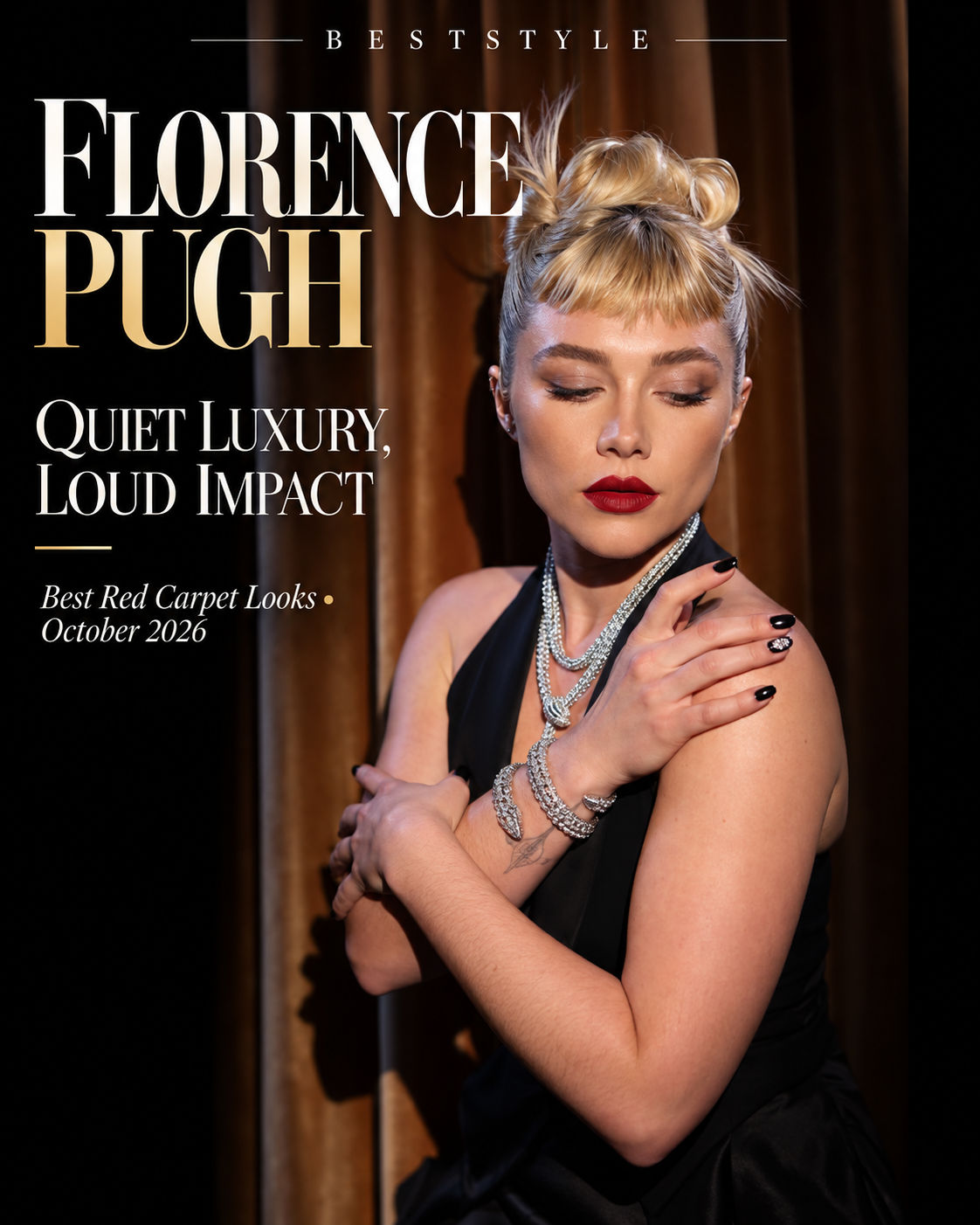
Red carpet dressing in 2026 is the art of communicating restraint as loudly as spectacle. Florence Pugh, at 28, has become the gold standard for this philosophy, consistently arriving at major events in pieces that whisper rather than scream. Her October 2026 appearances have been nothing short of a masterclass in quiet luxury—think minimalist silhouettes, strategic cutouts, and neutral palettes that somehow feel rebellious. This season, she's favored designers like Valentino, Bottega Veneta, and emerging London labels, proving that expensive doesn't always mean ostentatious. From the British Fashion Awards to Venice premiere circuits, her styling choices have dominated the conversation. Vogue's recent feature highlighted how Pugh's understated approach has shifted celebrity dressing away from maximalism entirely.
What defines Florence Pugh's red carpet aesthetic in 2026?
Florence Pugh's 2026 red carpet signature is rooted in architectural simplicity, neutral color grading, and pieces that feel inherently expensive because they *refuse* to try. She gravitates toward monochromatic palettes—creams, blacks, soft greys—interrupted by unexpected textures: leather, silk, structured wool. Her styling philosophy leans into old money sensibilities without feeling costume-y, and she pairs statement jewelry sparingly with minimal makeup, allowing the clothing to breathe.
Color palette dominance: Neutrals (cream, charcoal, sand) comprise 80% of her 2026 appearances, with occasional forays into muted terracotta and deep burgundy.
Silhouette strategy: Midi-length, column dresses; tailored separates; occasionally oversized blazers worn as gowns—always maintaining a clean line from shoulder to floor.
Cutout placement: Strategic asymmetrical or side-back cutouts add intrigue without reading as overtly sexy; the effect is intellectual rather than showy.
Fabric hierarchy: Heavy reliance on technical fabrics (structured jersey, matte silk, crepe) that photograph cleanly and move deliberately.
Accessory restraint: Minimal earrings, no visible branding, shoes that match leg line exactly—the goal is total harmony, not contrast.
Pro Tip: When building a quiet luxury red carpet look, focus on *one* unexpected element (a cutout, an asymmetrical hem, unexpected proportion) and let everything else recede into elegance.

How does Pugh balance minimalism with standout moments?
The tension between being memorable and being understated is where Florence's genius lives. She doesn't compete for attention through volume; she competes through precision. Every October 2026 appearance feels intentional to the point of inevitability—as though there was literally no other choice. This is achieved through a three-part framework.
Select one tonal anchor. Choose whether the look will be warm-neutral (cream, camel, gold-toned metallics) or cool-neutral (grey, black, silver-toned metallics). Never mix both in a single look.
Introduce one textural surprise. Leather panel on silk, glossy patent details on matte crepe, or a structured element on a flowing base. This creates visual intrigue without chromatic noise.
Define one structural statement. An unexpected neckline, asymmetrical hem, or cutout placement that signals intentionality. This is your "thing"—the element that people remember and dissect.
Scale proportions to match architecture. If the neckline is complex, keep the silhouette simple; if the silhouette is voluminous, simplify the neckline. Never compete across multiple zones.
Lock down the finish through styling restraint. Let hair, makeup, and accessories become negative space. The dress is the story; everything else is punctuation.
"Florence has figured out what it takes most people years to understand: luxury whispers because it doesn't need to shout."

Step-by-step styling guide to recreate a Florence Pugh red carpet look
The magic of recreating a Pugh moment isn't about buying the exact dress—it's about understanding the logic underneath the look. Here's how to build your own quiet luxury red carpet moment, regardless of budget.
Source a neutral base in premium fabric. This is your foundation: a floor-length dress in cream, black, grey, or warm camel in a high-quality material (silk charmeuse, structured jersey, matte crepe). Budget options exist—look at COS, & Other Stories, or MANGO's evening collection starting at $89.99. Luxury iterations start at $1,500+.
Introduce one structural or textural surprise. This could be an unexpected cutout, asymmetrical hem, side slit, or tonal paneling. The surprise should feel architectural, not decorative. If buying ready-made doesn't work, a tailor can add a subtle back keyhole or side seam cutout for $150–400.
Select footwear that matches leg line. Nude or tone-matched heels (or flats, if Pugh-coded minimalism is your vibe) create a vertical line that elongates the silhouette. Avoid contrasting colors or eye-catching details.
Choose jewelry that disappears into the look. One pair of understated earrings—gold hoops, pearl studs, or minimalist drops—or skip earrings entirely and let a statement ring (if any) live on the hands. No necklace unless the neckline is deeply cut.
Finalize with restraint in hair and makeup. A clean slicked-back bun, soft waves, or a simple center part keeps the focus on the dress. Makeup should be luminous but not colorful—think skin, not eyeshadow; natural lip or nude gloss, not statement red.
This framework works whether you're shopping AKIRA's affordable options (bodycon and satin pieces from $24.99) or investing in a Valentino piece ($2,800+). The difference isn't in price; it's in coherence. A $40 H&M dress styled with Pugh-level restraint will read infinitely more expensive than a $3,000 dress worn with clashing jewelry, busy hair, and heavy makeup.

How do you avoid looking cheap when minimalism is your strategy?
Minimalism is a luxury tell because it requires confidence and *investment*—either financial or intellectual. The biggest pitfall people make is assuming that fewer pieces automatically equal less cost. In reality, fewer pieces *demand* higher quality because there's nowhere to hide. Here's how to ensure your restrained look reads premium, not budget.
Fabric weight matters more than brand name: A dress made from dense, high-thread-count silk charmeuse or structured Italian crepe will photograph and move like a luxury piece, even if the label is unfamiliar. Synthetic or thin materials read instantly as cheap, no matter the designer.
Seaming and construction are invisible tells: Run your hands along seams. Quality seams lie flat, even; cheap seams pucker, wobble, or have excess thread. Ask the retailer for close-up photos of hems and armholes before buying online.
Fit is non-negotiable in minimalism: Because there's no pattern or embellishment to distract, an ill-fitting minimal dress screams amateur hour. Budget $50–150 on tailoring to ensure the dress skims your body without clinging or drooping.
Color grading prevents visual chaos: Avoid jarring contrasts (white shoes with black dress, silver jewelry with gold dress). Stick to one metal tone, one temperature (warm or cool), across your entire look.
Grooming elevates everything instantly: Polished nails (clear, nude, or single-tone), clean hair (no frizz or greasiness), and smooth skin read as luxury faster than any designer logo. This is free or low-cost and makes a $60 dress photograph like $600.
Florence Pugh's October 2026 appearances illustrate this perfectly. At the Valentino show, she wore a tailored Valentino column dress in charcoal—approximately $2,400—but the power of the look came from immaculate grooming, flawless tailoring, and zero visual distractions. The same silhouette from an affordable brand would still read as expensive *if* the fit was perfect and the grooming was flawless.

My years watching Florence Pugh master red carpet restraint
I have spent years covering red carpet cycles, watching trends rise and collapse, and observing which celebrities actually *evolve* their approach versus which ones cycle through the same patterns. Florence Pugh has become something rare: a young celebrity who understands that the most powerful statement is the one you *don't* make. She doesn't need to shout; her presence does that work.
In October 2026, I watched her arrive at a London premiere in a cream Bottega Veneta column—the kind of dress that requires absolute confidence because there's nothing between you and the fabric. Most younger celebrities would have accessorized it into submission: a bold clutch, layered jewelry, a dramatic lip. Pugh wore barely-there makeup, minimal jewelry, nude heels that disappeared, and let the dress *be the dress*. The moment photographs traveled across every major fashion outlet within hours. That's the Pugh effect: quietness as the loudest possible statement.
What strikes me most is how her approach has trickled down through the industry. Stylists are now actively *removing* elements from red carpet looks rather than adding them. The question has shifted from "What else can we put on her?" to "What's the absolute minimum that makes this sing?" That's a seismic shift, and Pugh accelerated it by refusing to play the maximalist game.

BestStyle's guide to red carpet dressing and celebrity style
BestStyle's editorial team covers red carpet moments not as isolated events but as cultural markers—windows into how luxury is being redefined, how gender norms in dressing are shifting, and which designers are actually steering the conversation. We track celebrity style because it's the fastest way to understand where fashion is heading six months before it reaches the mainstream. When Florence Pugh makes a choice, it ripples through the entire industry; when she commits to quiet luxury, suddenly every young actress is reconsidering their maximalist impulses.
Our coverage spans red carpet analysis, designer deep-dives, and accessible styling guides that help our readers translate celebrity moments into wearable reality. October 2026 is notable because it marks the moment when restraint became the ultimate flex. We're documenting this shift because it fundamentally changes how you should think about dressing for important events—whether that's a gala, a corporate dinner, or simply a moment where you want to feel like the most expensive version of yourself.

FAQ
What brands does Florence Pugh typically wear to red carpet events?
Pugh favors Italian and British heritage houses—Valentino, Bottega Veneta, Miu Miu, and emerging London labels like Palmer/Hinson. She's also worn emerging designers like Rui and emerging sustainable luxury brands that align with her quiet luxury philosophy.
How can I recreate a Florence Pugh look on a budget?
Focus on high-quality neutral pieces from COS, & Other Stories, or MANGO (starting at $60–120), invest 30% of your budget in tailoring to ensure perfect fit, and apply strict styling restraint. The Pugh effect comes from coherence, not expense; a perfectly-fitted $80 dress styled minimally will outperform a $500 dress with clashing accessories.
Does quiet luxury mean I cannot wear color to formal events?
No—quiet luxury embraces color, but strategically and muted. Think terracotta, deep burgundy, or soft sage rather than bright red or neon. The rule is cohesion over contrast; if you wear color, let everything else (accessories, makeup, shoes) recede into neutrality.
What fabrics should I prioritize for an expensive-looking red carpet dress?
Silk charmeuse, matte silk, structured crepe, technical jersey blends, and Italian wool. These fabrics drape cleanly, photograph beautifully, and maintain their silhouette throughout the night. Avoid synthetics and thin materials; they wrinkle instantly and read as budget.
Is tailoring really necessary if I am buying designer pieces?
Absolutely. Designer pieces are cut on industry-standard sizing, which doesn't account for individual body variations. A $2,000 dress that's poorly fitted reads worse than a $200 dress that's perfectly tailored. Budget $100–200 for hemming, taking in seams, or adjusting shoulders.

Recommended
Bottega Veneta and the Quiet Luxury Movement: A Complete Guide — BestStyle
How to Style Neutral Tones Like a Luxury Editor: The Monochrome Masterclass — BestStyle
Red Carpet Tailoring Hacks That Transform Designer and Budget Pieces Alike — BestStyle
Young Celebrity Style Icons Redefining Minimal Dressing in 2026 — BestStyle


